
Emergence of AI over 75 years...
Although it’s commonly thought that AI has only been around for the past decade, its origins date back to the 1950s!
At that time, its use was largely confined to universities and research laboratories, however, by the 1990s, its influence was extending into the commercial sphere through search engines, recommendation systems, and fraud detection programmes. Although it was still being classed as ‘specialist’ technology, public awareness of AI was beginning to grow.
The years from 2010 to 2022 saw major breakthroughs in deep learning, dramatic improvements in image recognition, and a rapid increase in translating and voice assistants. Investment in AI rose quickly, with major companies (Google, Microsoft, Meta and Amazon) hastily adopting it, and public access to it increasing via news streams and social media platforms.
In recent years AI consumption has skyrocketed. Just five days after it was first launched, ChatGPT reached 1 million users, and at an estimated $850 billion, OpenAI is one of the most valuable private companies in the world. AI is now used in schools, businesses, and governments worldwide, and is increasingly becoming mainstream for public users.
AI Energy Consumption
AI’s energy consumption varies depending on what it is being used for.
Most people typically access AI via search engines such as ChatGPT, Microsoft Copilot and Google’s Gemini. A simple query uses just 0.1 to 1 watts per hour (Wh), while a more detailed and complex query might demand between 1 and 10 Wh. To put this into perspective, charging your phone will usually require 10 to 20 Wh, while boiling a kettle can use as much as 80 to 120 Wh. So a typical AI conversation will use far less energy than other daily activities but will still require more than a standard web search.
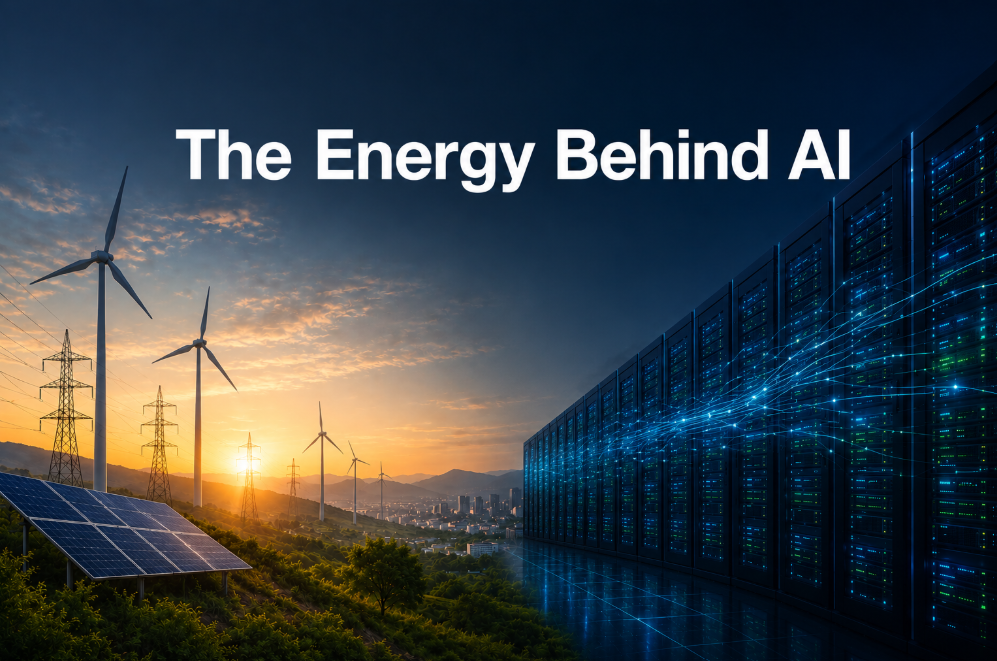
The real power consumers, however, are the large AI data centres and incoming larger AI models. GPT-3 requires vast amounts of energy (around 1,200 to 1,500 megawatts per hour (MWh) – enough to power 300 to 500 average UK homes for a year. The largest planned AI data centre facilities could exceed consumption of 1 GW, which is similar to the output of a large nuclear power station and requires roughly the same amount of electricity as almost 1 million homes.
Are there any other resources AI is depleting?
Energy isn’t the only thing AI consumes. Data centres are heavily dependent on fresh water for cooling purposes – it’s estimated that they can use millions of litres of water per day. Researchers at UC Riverside have calculated that by 2027, global demand for AI could result in data centres consuming over 1 trillion gallons of fresh water. This is an increasing concern in drought-prone regions, with some companies shifting to recycled water and air cooling, or relocating their data centres to countries with cooler climates to reduce ongoing demand.
AI hardware also relies on critical minerals and finite earth elements that are expensive to source and in short supply (copper, silicon, cobalt, nickel etc). Extracting these resources can have significant environmental implications as well as bringing geopolitical supply risks, as the majority are found in African and South Asian countries
Balancing Innovation with Sustainability
Despite the challenges, AI also has the potential to help support some sustainability objectives. It is used to optimise electricity networks, improve renewable energy forecasting, reduce waste in manufacturing processes, and accelerate scientific research projects.
Within the property and infrastructure industries in particular, use of AI is beginning to improve asset management and planning processes by helping organisations to make more informed decisions.
It’s likely that over the next decade we’ll see AI become embedded in many aspects of the economy, and therefore the UK’s electricity network, planning systems and digital infrastructure will need to evolve alongside it. For organisations operating across the sector, understanding the implications of AI will become increasingly important. Those who are involved in land acquisition, planning, renewable energy, and infrastructure delivery will all need to play their part in ensuring that the UK’s digital future can be supported in a sustainable way.