
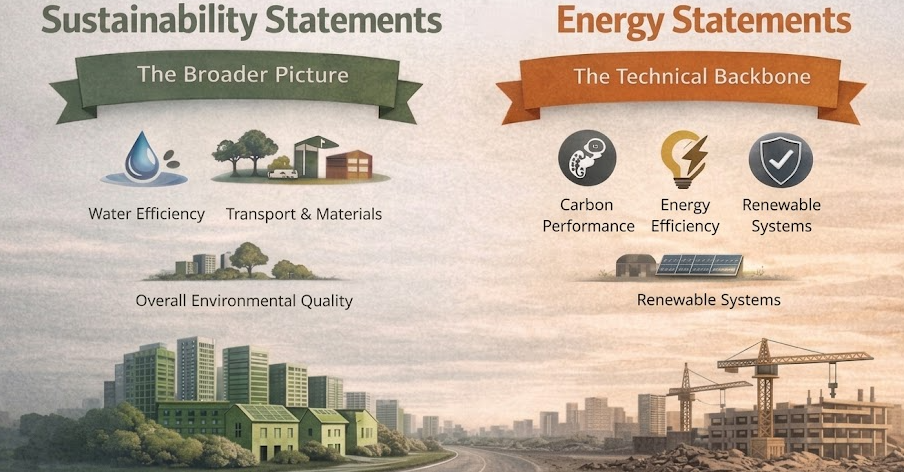
The relationship between Energy Statements and Sustainability Statements can often lead to confusion. While the two are sometimes combined, they serve different purposes. An Energy Statement provides the technical backbone, demonstrating compliance and carbon performance. A Sustainability Statement, on the other hand, tells the wider story, addressing considerations such as water efficiency, materials, transport, climate resilience, and overall environmental quality.
When handled well, this broader strategy can strengthen a planning application and reduce perceived risk from a local authority’s perspective.
However, problems can arise quickly when a scheme’s energy requirements are not clearly understood or challenged early enough. Developers can find themselves facing planning conditions that are disproportionate or misaligned with regulatory standards. Requirements for significant carbon reductions, complex heating strategies or extensive on-site generation can all add pressure to a scheme, particularly if they haven’t been factored in from the start.
It’s not uncommon for this to lead to substantial, unplanned costs. In some cases, schemes have absorbed major financial impacts simply because the energy strategy was addressed too late, forcing developers into redesigns or expensive offset payments.
At BTS, we work with developers to ensure that the above scenario is avoided. Interrogating planning policy, challenging where necessary, and aligning energy strategies with the wider utilities and infrastructure approach, helps to ensure that solutions are proportionate and viable. The focus is not just on meeting requirements, but on doing so in a way that developers and housebuilders can realistically deliver.
Energy Statements shouldn’t be seen as one more obstacle to get over. If they are approached strategically, they can be an invaluable tool that will unlock planning, reduce risk and protect value. Engaging with them early on will increase your advantage.