
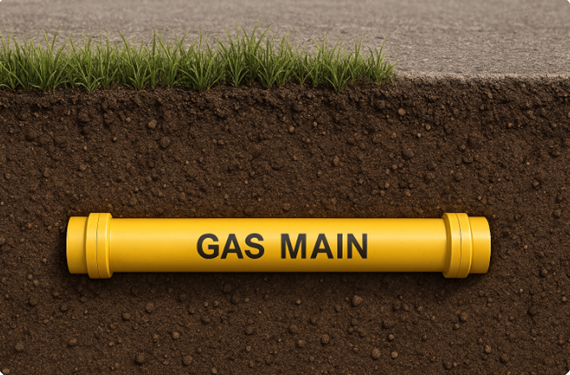
Not all development challenges are visible from ground level. High pressure gas mains are a perfect example of how what lies beneath can shape or sometimes prevent what happens above. These major pipelines, often running across strategic land parcels or potential housing sites, come with significant safety and legal restrictions. Any development proposed in proximity to a gas main will be subject to strict Health and Safety Executive (HSE) consultation zones, which can limit building footprints, restrict access routes, or even render parts of a site undevelopable without a major redesign.
Too often, these constraints are discovered late in the planning process, when layout changes are likely to be costly and time-consuming. Developers may also face additional requirements for easements, stand-off distances, or diversion works, all of which can delay delivery and erode a development’s viability.
At BTS, we specialise in identifying these risks early. By using detailed utility mapping and engaging early with gas network operators, we help developers to understand the precise locations, classifications, and impacts of any medium or high pressure gas apparatus before planning or design work goes too far.
Early awareness means that informed decisions can be made, whether that’s adapting layouts, negotiating with operators, or exploring diversion options.
High-pressure gas mains might be out of sight, but they should never be out of mind. For developers, the key is not just finding out that they exist, but understanding how to plan around them safely, efficiently, and strategically.